Portfolio

My work spans three main areas: AI tooling design, UX design, and content design. Many projects also involve a leadership dimension — setting standards, building communities, or creating tools that scale good practice across large organisations.

See also: my experience and skills, articles, and testimonials.

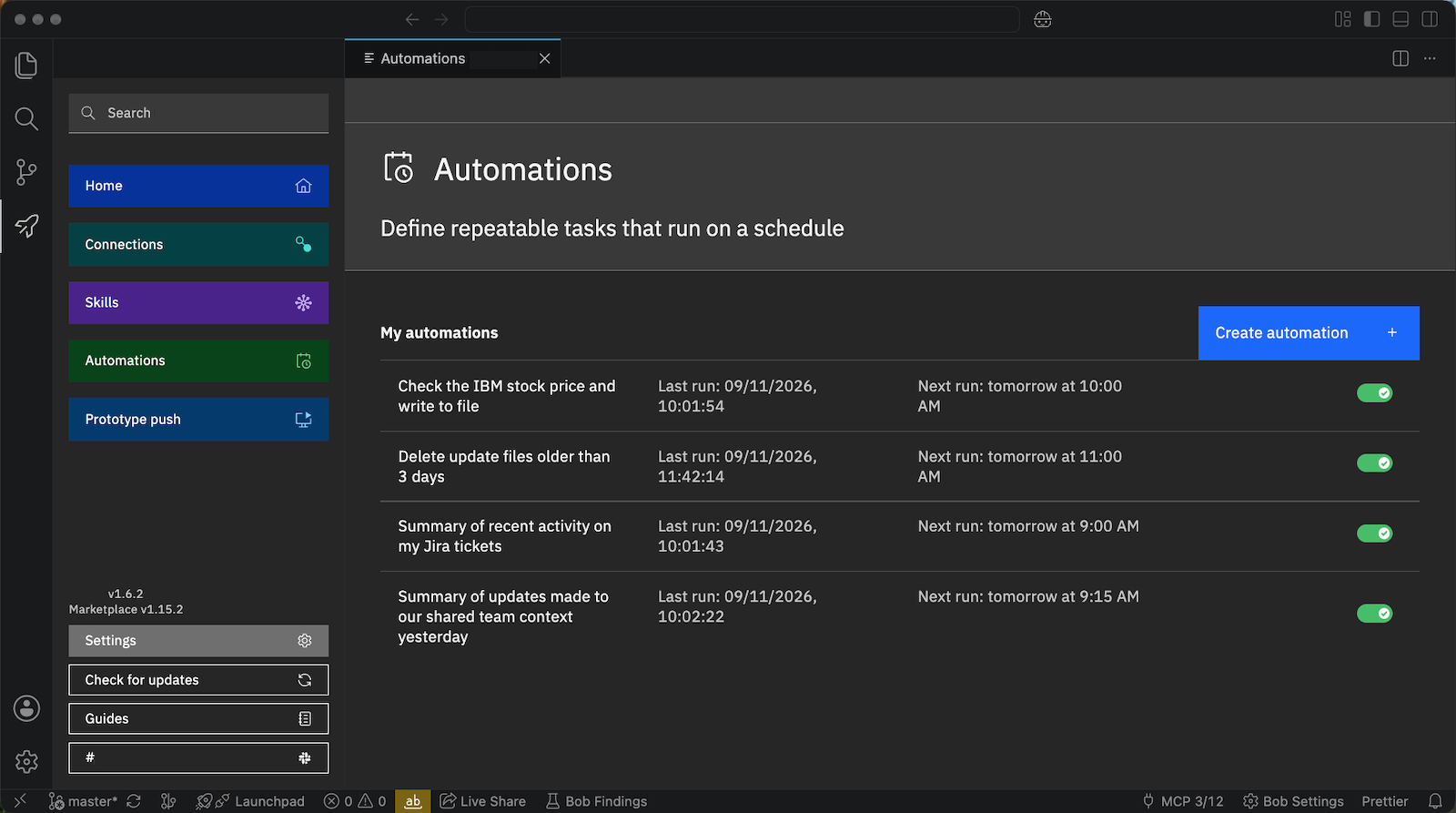
Screenshot of the Automations page in the AI tooling extension, showing a list of scheduled tasks and a Create automation button

A sample page within the AI tooling extension that I'm the Design Lead for

AI tooling designUX designLeadership

Leading design for AI tooling

Designing an AI tooling extension used by IBM Software

  • I work on an AI tooling extension for IBM Bob. The extension helps IBM Software product team members use Bob for AI-native product development lifecycle (PDLC) work.
  • As one of the product's leads, I influence our roadmap, define design priorities, plan user research, and verify that features are implemented as designed.
  • Users can quickly connect Bob to the tools they already use, such as Amplitude, GitHub, and Jira. Bob can then retrieve information, pull in context, and take action on the user's behalf, without them having to switch between apps.
  • The extension also lets users create scheduled automations, publish and share prototypes, sites, and docs with built-in commenting, invoke skills with chat shortcuts, and control which MCP servers and skills Bob loads.
  • The extension has over 4,000 weekly active users.
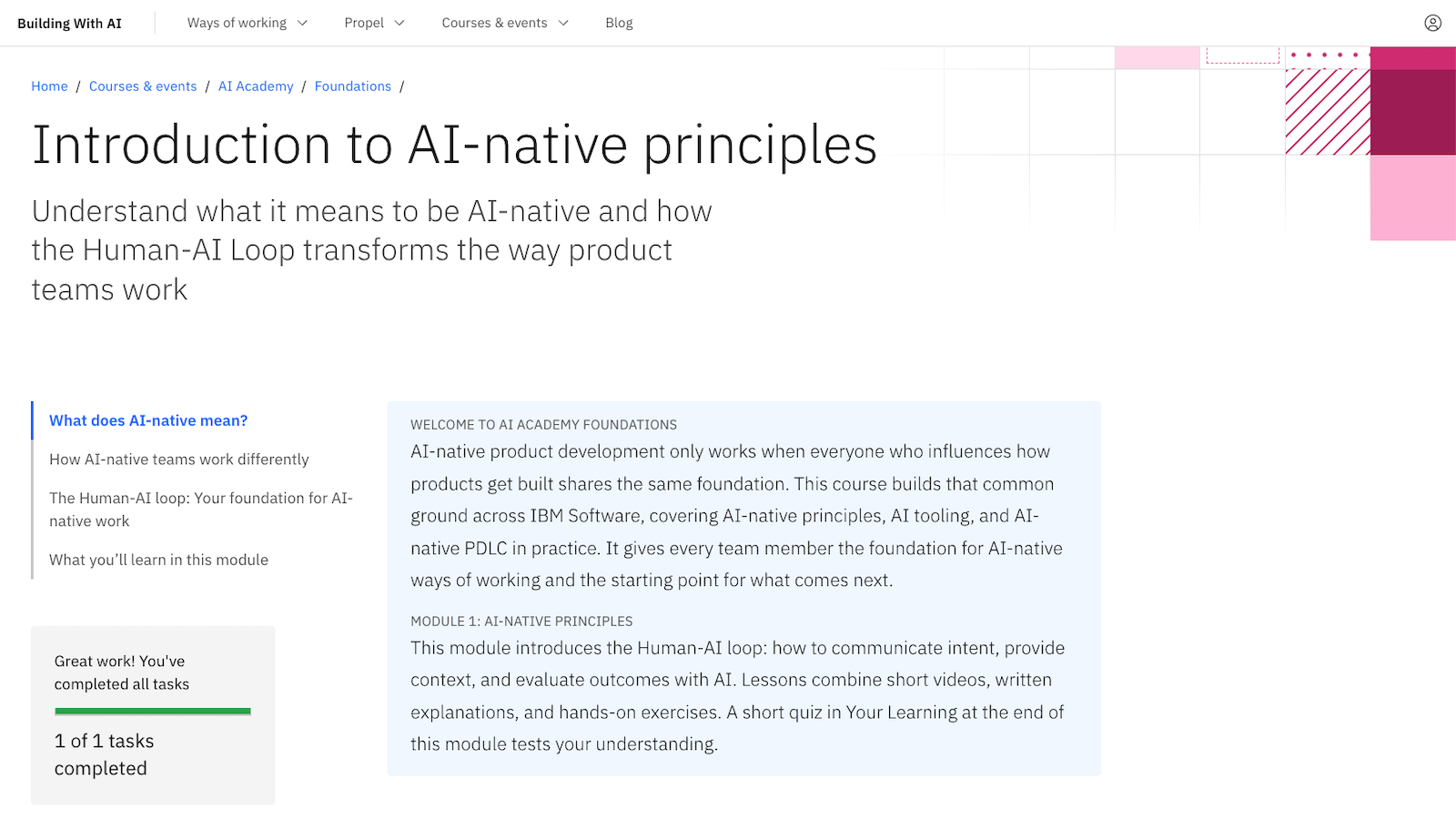
Screenshot of the Introduction to AI-native principles module in the AI Academy Foundations course

A module from the AI Academy Foundations course that I helped deliver

AI tooling designLeadership

Designing an AI course

Helped deliver an AI course for 25,000 IBM employees

  • AI-native product development only works when everyone on a team shares the same foundation. In 2026 I helped design and deliver a course for IBM Software that builds that common ground for all employees, whatever their role.
  • I was one of four people on the core team. The course, AI Academy Foundations, is hands-on and takes about 5 hours. Its three modules cover AI-native principles, AI tooling, and AI-native product development in practice.
  • The course has three role-specific tracks, for product managers, designers, and engineers. Each learner is assigned the track that best matches their role, and is encouraged to explore the others, since AI enables teams to work more collaboratively across disciplines.
  • We built the course using the AI-native approach it teaches, and iterated on it using feedback from a pilot and 47 user research engagements with product managers, designers, and engineers.
  • The course was rolled out to approximately 25,000 employees across IBM Software, and has a completion rate of over 90%.
Screenshots showing the AI assistant

The release management AI assistant that I delivered

AI tooling design

Delivering an AI assistant

Enabling users to get quick answers to their questions

  • Some IBMers were struggling with the many internal IBM release management processes. To help such users, I configured and deployed an AI assistant.
  • I used the IBM watsonx Orchestrate platform to connect the assistant to a documentation set that I had written.
  • The AI assistant is embedded directly in the internal release management application that product managers and other colleagues already use.
  • The AI assistant responds to users' natural language questions, providing a summary response as well as links to further details.
  • The assistant helps users quickly find answers to many questions without needing to ask colleagues or search internal web pages.
Screenshot of the content checker Figma plugin

The content checker Figma plugin that I helped create for IBM designers

AI tooling designContent design

Creating a Figma plugin that checks content

Helping IBM designers easily check and improve the written aspects of their designs

  • While we have good content guidelines at IBM, it's easy for designers to forget aspects, sometimes leading to poor UI content.
  • I came up with the idea of providing them with a way to check the written content of their product UI designs directly within Figma.
  • Some colleagues helped me get a prototype AI-powered Figma plugin running and I then worked on providing the content rules for the AI model to reference.
  • I iteratively tested the plugin on example Figma designs and refined the content guidelines and LLM settings until the plugin was ready to publish.
  • The Figma plugin is now being used by over 250 IBM designers, helping them perfect their UI content.
Screenshot of the IBM Event Streams product UI

An example: the IBM Event Streams product UI that I worked on

Content designUX design

Writing UI content

Working with product teams to deliver great content

  • I work with lots of different IBM product teams. For example, I joined the IBM Event Streams team for a period of 5 months.
  • I ran a content audit to help the team review what content they had, what user needs it addressed, and what needed removing, updating, or creating.
  • After learning about the target users, I wrote all of the UI content for the new features the team were working on.
  • I helped the team design a new set of marketing pages that articulated how the product addressed common user goals.
  • We won external design awards 🏆 for both the product itself and the docs site.
Screenshot of the content guidance section within the Carbon for IBM Products site

The content guidance section that I wrote and maintain

Content designLeadership

Setting content standards

Providing guidance to IBM designers on all aspects of product content

  • Back in 2016, I was asked to produce IBM Design's first voice and tone guide. I started with thorough research to understand what aspects of writing designers and engineers were struggling with. I've written about this process in this article.
  • I then focused on how we could best design and deliver the guidance so that it would be fun, useful, and easy to use.
  • When IBM adopted the Carbon Design System for all product UIs, I began contributing to both the brief external and more extensive internal content guides.
  • This is something that I and others continue to evolve — Carbon is used by hundreds of IBM product teams, as well as many outside of IBM.
Three survey pages: an open cloze test with a blank to fill in, a closed cloze test with a list of word options, and a page asking users to define terms such as Integrate, Connector, and API

Examples from the terminology cloze test that I ran

UX designContent design

Researching and testing terminology

Ensuring that the words we use communicate clearly with our target users

  • One IBM product team was showing potential customers early product designs and noticed confusion around some of the terms being used.
  • The team were divided about which terms to use, so I was asked to help resolve these terminology issues.
  • I designed and ran a 'cloze test' research study where recruited target users were given a series of sentences and asked to supply missing words.
  • This research provided the team with empirical data showing which terms resonated with the target audience and which did not.
  • This enabled the team to make informed decisions about which terms to use, based on real evidence about their users' mental models.
Screenshot of the IBM UX writing course

The IBM UX writing course that I published in late 2022

Content designLeadership

Delivering content education

Creating a UX writing course for all IBM designers

  • IBM has a community of over 3,000 designers. While we have dedicated content designers, many design teams don't have access to a content specialist.
  • In 2022, I was asked to create a self-service online course to help UX designers, visual designers, and design researchers improve their UX writing skills.
  • After getting input from a variety of design colleagues, I came up with a course outline that mapped to both our Carbon content guidelines and internal design review heuristics.
  • As I drafted each module I sought feedback from early adopters, enabling me to refine the content until it was ready for publication.
  • Since it was published, the UX writing course has been accessed thousands of times.
Pages from a content assessment report, showing an overall grade, section ratings for terminology and help content, and written feedback on an error message

Examples of the detailed content reviews I provide to product teams

Content design

Providing content assessments

Helping product teams to further improve their UI content

  • Sadly, many IBM product teams do not have a dedicated content specialist.
  • While they have content guidance to follow, their UI content often has scope for improvement.
  • Before being released, all products go through a formal 'Design & User Experience' review and I often provide the content-specific part of this assessment.
  • I assess the written parts of the product UI against a set of content heuristics and provide detailed feedback highlighting both strengths and areas for improvement, along with suggestions and supporting materials.
  • Over time, the content quality of IBM Software products has demonstrably improved over successive product reviews, as teams receive tracked content feedback and make improvements for their next release.
Festival website homepage with a purple background, yellow starburst graphics, and the dates September 26 to 29, 2023

The website for the internal IBM Spark Design Festival 2023

Content designLeadership

Writing for the Spark Design Festival

Writing the comms for the internal 2023 IBM Spark Design Festival

  • For the last few years, IBM has run a fantastic annual design festival featuring presentations, lightning talks, panel discussions, and workshops.
  • I joined the leadership committee in 2023, responsible for all festival content and communications.
  • I worked closely with committee members, speakers, and volunteers to ensure all festival information was communicated clearly and on-brand.
  • This involved writing website copy, event emails, and many Slack announcements before, during, and after the festival.
  • A colleague and I also started a monthly Spark blog, each edition exploring one design topic and featuring talks from the Spark archives.
Screenshot of our IBM Content Design Guild Slack channel

Our IBM Content Design Guild Slack channel

Content designLeadership

Establishing a community of practice

Bringing together colleagues who have a passion for great content

  • Back in 2018, many people in IBM hadn't even heard of a content designer, let alone worked with one.
  • So I got together with the talented Maranda Bodas and a handful of others, and we formed a small community of practice: the IBM Content Design Guild.
  • From an initial meeting with just 7 of us, our community has grown month by month — we now have 50+ people at our monthly meetings and 500+ in our Slack channel.
  • At our lively meetings we share best practices and resources, run content crits, and learn about different aspects of content design and strategy.
  • You can read more about how we established this vibrant community in this article.